May 10, 2014

Jane Austen's Life Instructions

Cindy R. Williams

I, like many of you, love all things "Jane Austen."  Today in Deseret Book, I bought a tiny four by five inch purple book for the small sum of $5.95 titled JANE AUSTEN'S LITTLE INSTRUCTION BOOK. Each tiny page makes me smile . . . and think.

Here are a few of her instructions:


  • "One cannot have too large a party."  Mr. Weston, EMMA
  • "Perfect happiness, even in memory, is not common."  EMMA
  • "It is very unfair to judge of anybody's conduct without an intimate knowledge of their situation."  Emma Woodhouse, EMMA
  • "Do not let us be frightened from a good deed by a trifle." Mrs. Norris, MANSFIELD PARK
  • "Do not let your kindness defend what your judgement must censure." Marianne Dashwood, SENSE AND SENSIBILITY
  • "Let us not desert one another." NORTHANGER ABBY
  • "There is no enjoyment like reading! How much sooner one tires of anything than a book!"  Miss Bingley, PRIDE AND PREJUDICE
  • "The liveliest effusions of wit and humour are conveyed to the world in the best chosen language." NORTHANGER ABBY
  • "How quick come the reasons for approving what we like." PERSUASION


I do say that Ms. Austen has a fine mind. Each of these statements gives one food for deep thought.


May 9, 2014

Be a Leader

Image

By Beckie Carlson

Today was my first 'professional day' away from school. My director asked me to go watch two other campuses do their "Leadership day" and observe their Lighthouse teams.  "Lighthouse" is what we call our student council here at ALA. I was flattered to be asked and excited to see what other campuses were doing.
One of the things I love about ALA is how we strive to empower our students. The 7 Habit method, The Leader In Me, by Stephen Covey is awesome. As educators, we add a leadership twist to every lesson we teach. I think all schools should be this way. One of the things that I heard announced at one school was that the Arizona Department of Education has approved the "Leader in Me" program statewide. This means, you can apply to be a part of it and your school can get a grant for it! I really don't know what all that means, but it's good!
At the leadership days, the students are in charge. The community is invited to come to the campus and look around. The students do skits, sing songs, give amazing talks, and basically show off their school. The 'grown-ups' are just in the background for support. Have you ever seen a kindergarten student lead their class through morning routines of counting, spelling, phonograms, etc. while an audience is watching? It is impressive.
At one school, a student gave a speech on what it meant to be a patriot. The school mascot is a Patriot and she used her grandfather as a great example of a patriot.  She did an amazing job. I almost cried! One of the things she said that stuck with me was this:
"We don't touch a thistle and pull back because we got poked, we grab the entire thistle in out hand and crush in." VERY loose translation, but still a really great image of taking life by the horns and getting the job done.
I was duly impressed by all the kids I saw today, working, synergizing, laughing, teaching, and growing. I am so glad I am a part of such a wonderful organization!
I'm also glad I'm at my campus....another campus had portable classrooms.....not sure I could survive in there. I need my windows!! Cause I said so!

May 8, 2014

Five Essential Story Ingredients, or What I Learned from Brian A. Klems


By Susan Knight


When I took a writing class not too long ago, the professor asked us to skim through magazines such as Writer’s Digest, write a blurb about an article we read, then present it to the class. I think that’s a very good idea. Writing helps us remember. And, as I'm writing, I want to remember this Writer's Digest blurb, taken from Brian A. Klems', The 5 Essential Story Ingredients.

First of all, what is a story? It is more than sentences put together to tell us something. Any recipe can do that, but a recipe is not a story. Nor is a menu or a catalog. However, he did compare writing a story to baking a cake. Mix up the ingredients in a specific order and the ingredients transform into something delicious.

He writes that one does not have a story until something goes wrong. Tension is needed, an antagonist is needed, scene, empathy, etc.

To “bake up a story,” Klems writes that a story has to have origination, an escalation of conflict and a resolution. A little more than pre-heat oven; bake for 35 minutes; serves six.

So, to bake a story, these five ingredients, according to Klems, are needed:

Ingredient #1: Orientation—the beginning of a story must grab the reader’s attention, orient to the setting, mood and tone, and introduce a protagonist readers will care about.

Ingredient #2: Crisis—we’ve heard of throwing rocks at our characters, but the protagonist must be able to pick him or herself up and solve the problem the rocks cause. The crisis could alter the protagonist’s life for the better, or worse, but his or her life will be changed. A crisis should encompass the antithesis of the protagonist’s desires. Crises can be interwoven internal and external predicaments. The more rocks, the better.

Ingredient #3: Escalation—the main character must change in some way. She will fail. She will try again, but she will fail again. During this ingredient, main characters should try to take steps to solve both types of crisis, internal and external. Let them both have the same conclusion. . . or not . . . which leads to the next ingredient.
 
Ingredient #4: Discovery--the main character makes the discovery that will change his life. It's the climax of the story. Discovery comes from choices. I love Klems' words: "In one of the paradoxesf storytelling, the reader want to predict how the story will end (or how it will get to the end), but he wants to be wrong. So, the resolution of the story will be most satisfyingen it ends in a way that is both inevitable and unexpected." Beautifully sai. It's the kid of reader I am.
 
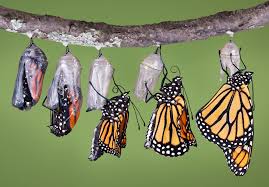
Ingredient #5: Change--Klems compared this ingredient to a caterpillar entering the cocoon stage. There are only two things that can happen: it will become a butterfly, or it will die. B will never be a caterpillar again. The old life is forever changed as the main character moves through the struggle ot the discovery into a new and different life.


Happy writing!

May 6, 2014

Is Re Posting ok?

by Terri Wagner

I happen to glance through what passes for a textbook in today's schools. Unfortunately, most of the material is composed of articles written by or dictated from decidedly slanted information, especially history and even geography. I remember when geography was simply what is the biggest country in the world populations wise? land wise? education wise? When I was taking a wonderful media class for education, I was delighted to discover that technology brings a much needed diversity in information. The following was a blog entry I made for that class. Now that I am in the school system, I think I was more right than I knew. So I'm re-posting this, hoping that's ok by ya'll.

Is there a difference between history and social studies? If so, what is it? What would be the most technically effective way to teach history? How is it being taught today? Evaluate The Center for Teaching History with Technology and Teaching History with Technology by Dr. Steven Hoffman comparing and contrasting their methods. Which is closer to your idea of teaching history?
picture of computer battle game
Dr. Hoffman teaches key critical history concepts through a World War II simulation software game. It is designed in such a way that students take on the leadership roles of the countries involved in the conflict. Some incidental learning takes place when the "leaders" learn they have to for example clothe their people, suddenly they have to trace textile imports. The game allows for changes in key decisions made in the war so a different outcome can be explored. Instead of a traditional history classroom with the odd poster, this is a computer room with a huge screen. The lights are dimmed, and the game begins.
ancient manuscript style
The website is hosted by edtechteacher, an organization with a mission to "...help teachers and schools leverage technology to create student-centered, inquiry learning environments." This site links to the site specially dedicated to history. The edtechteacher also has a blog I am now following, accessible from either website. The history center contains a page dedicated to why teach history with technology with the most important reason being the one I share...teaching students with the tools they are already familiar with in a way they like to learn. Few students today have the desire to slug through outdated dusty old journals to find gems of knowledge; however, they will search for hours on Google. It just makes sense to follow their lead. The site also contains multimedia presentations, lesson plans, blogs, chats, mindmapping, and word clouds. Each item is explained. You can also access teacher assessment tools to evaluate learning progress. Dr. Hoffman's philosophy about his decision to utilize simulation software is much the same as the Center's. Both believe in tapping into the student's familiarity with the computer and using it to teach them critical thinking. To me the whole point of history is to learn what has worked and what has not. I cannot think of a more effective way to demonstrate that than experiencing it...and now we can virtually. I wholeheartedly embrace technology learning for a history class. My beef has been and probably will continue (until and unless I can change it) that what passes for history in K-12 is actually a mixed grouping of social, economical, anthropological, and historical information, some and much of which is geared to a predetermined conclusion. For example, a historical perspective would be: did the windmill hill people actually exist? Where were they located? Critical thinking could be: could they have been the builders of Stonehenge? Today, for what passes as history, the footnote would more likely be: 4,752 years ago, a group of nomadic people settled near what today is Stonehenge. Most likely, they were hunter/gatherers who decided to stay on the grassy plain and become the farmers of the ancient world. Since such people were deeply religious, they used the stones to make a circle to determine the seasons, the time, and to serve as a place of worship. The windmill hill people were most likely the ancestors of the pagan Druids. Am I alone here in suggesting (gasp) that we just study what we may know about the windmill hill people, and acknowledge the rest is speculation? That to me is the joy of history. Learning what is really factual and what is interesting speculation. As long as these are labeled correctly, learning from history can be fascinating.